Originally published July 8, 2009 by New York Press
 Summer in New York is long, slow, hot and brutal—especially for art galleries. Many of the people who might actually buy something are out of town, and the traditional tourist is not known as a big art consumer. Few artists or galleries want to commit the time and money to a one-person show. Hence the rise of the phenomenon known as the “summer group show.” Galleries come up with overarching themes that give them good excuse to mount large group shows that often have a little of something for everyone. They’re lots of fun, but rarely earth shattering.
Heist Gallery on the Lower East Side is hoping to change that. The Essex Street gallery has decided to devote its entire summer to shows about New York City. Entitled “The City’s Summer Heist,” the programming involves a series of quick hit two-week exhibitions that will alternate between solo and two-person shows, mounted both inside and outside of the gallery itself and will include video, photography, performance, sculpture and painting that all relates to summer in the City. The summer programming began on June 30 with site-specific video installations by Liz Magic Laser. The display consists of three performance-based video and photographic works set in bank vestibules. She has produced a version of the Bertolt Brecht play Man Equals Man in the vestibule of a Chase bank branch. Man’s relationship to ATM? It will be interesting to see what it all means.
The second show is a twofer. Tim Hailey and Milton Carter do not explicitly work together, but the curator has paired them, in a series of events woven together by their fascination with motorcycle culture and promises the project will “thrill and shock” gallery viewers (not to mention the neighbors). Ladies and Gentlemen, start your engines! Personally, I think Evil Knivel jumping the fountains at Cesar’s Palace represented the ultimate motorcycle art, but perhaps Tim and Milton can top it.
Installation number three is a multimedia and video performance TV show by Jennifer Sullivan. She will set up what looks like a nutty TV studio in the gallery and produce a daily program that will star both her and her artwork. The gallery press release promises “possible disaster.” Heist’s owner Talia Eisenberg says, “We don’t know exactly what the show entails because we are giving her full creative reign starting from day one through the end of the second week.” So far, the gallery programming seems to promise both thrills and danger. I guess that’s all part of life here in Sin City. Stay tuned.
The fourth and most intriguing exhibition is in more traditional-looking media and depicts radically different visions of the city. Tim Feigenbaum’s “Trainset Ghetto” will attempt to create a cinematic, hyper-real miniature environment based on 1980s-era decaying New York City—using model railroad supplies he has created an empty film set of our town. Eerie, beautiful lighting gives these pieces a surreal glow. Marissa Blustones’ large paintings depict a dream-like vacation from the city that becomes a nightmare. Semi-clothed figures dot a rural landscape that seems ready to explode upon impact. Lush and colorful, these scenes are truly terrifying. The moral of the story is never leave the city! It’s a jungle out there.
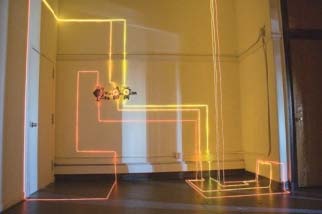 LET’S GET THE obvious question out of the way: A “snatch block” is the part of a crane that the hook is attached to. Given that the co-owners and curators of Snatch Block Projects are hard-core steel welders, this seemed like a natural name for their new art venue. Not commercial, not even alternative, it is “a place and a chance to do whatever we want,” curator John Clement explains. And so they have. You get off the L train, far beyond Bedford Avenue and you walk and walk and then walk some more. You pass a couple of chop shops, a tortilla factory (buy a bag fresh off the grill from the loading dock!), over the English Kills Canal, past the local strip club and you reach a Victorian firehouse.
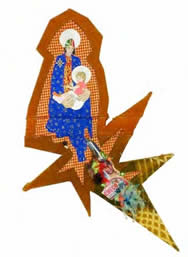 In the No, a thought-provoking exhibition at Edlin Gallery, challenges some of our basic assumptions about outsider artists. The mythology is that outsider artists exist in a state of “not knowing.” They live in a kind of innocent ignorance about the mainstream art scene and often about the world at large. The question becomes how much does our fascination with the artist’s own back-story affect our response to the work.
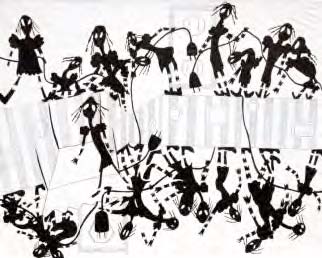 The work of Penny Rockwell, currently showing at Pavel Zoubock Gallery, is harrowing, intimate, sad and beautiful. She has documented with painful honesty the progression of a psychotic break that she suffered in the early 1990s, one fueled by paranoid delusions that electrical plugs were evil animated beings that were after her. After 10 years of therapy—and medication—she has attempted to recreate and communicate the absolute terror of this experience.
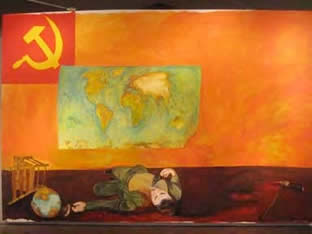 The current exhibition at Hebrew Union College Gallery seems particularly apt for 2008. Envisioning Maps is a giddy investigation of maps and more interestingly, the underlying concept of “mapping;” getting lost, getting found and staking out a place to belong in the world. Whether it’s a historical scarf mapping the invasion of Normandy or Paula Sher’s staggering, insanely wordy map of Israel and its neighbors, the desire to know where one is resonates loudly in a world where we don’t seem to know where we are going.
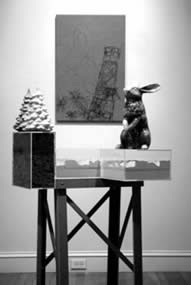 A bizarre menagerie of creatures has come to roost at Greenwich House Pottery. A venerable institution not known for experimental or conceptual exhibitions, its current show will certainly change the view of GHP as a “pottery school.”
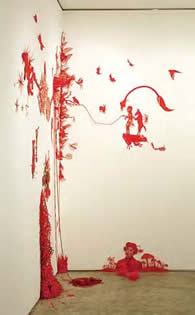 “SELF-PORTRAIT (OCTOPUS Head)” doesn’t sound like it would be beautiful. But thanks to the beautiful, nutty work of Tokyo-born, Brooklyn-based artist Kako Ueda, a human head,grafted onto an octopus’ body and either eating or expelling agiant frog, is delicate and beautiful; it’s man and nature in tenuous harmony.
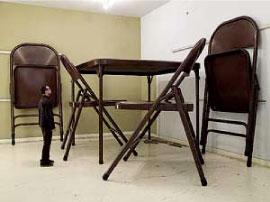 Chelsea, home to some of the most self-important, pretentious, even grim artwork these days, is currently host to an exhibition that is so beguiling and delightful that even the gallery guards are smiling. The Gagosian Gallery is exhibiting the current work of Robert Therrien, a Los Angeles sculptor whose art has long defied both categorization and fashion. The gallery has been invaded by banal but gigantic objects. Stacks of oversized plastic dishes in the pale colors of old lunchrooms are piled 8-feet high. Towers of pots, pans and bowls come in three sizes: miniature, normal and enormous. They are perilously balanced as if a chef gone mad has left them like totems throughout the gallery.
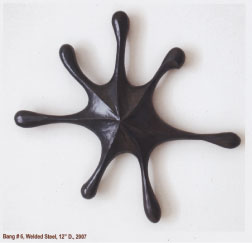 Whenever I visit Williamsburg I feel transported to a different time and place—a rough-and-tumble college town somewhere in America about 10 years ago. Sometimes annoying, often refreshing, it’s always a relief from Manhattan. The same is true for the gallery scene. The artwork runs the gamut from the silly and insignificant to the occasional diamond in the rough. On Friday afternoon I discovered a real jewel.
 What do you do when you read the press release for an exhibition, study the catalogue with Talmudic intensity and still can’t figure out what the purpose of the show is? Such was the case for me upon seeing Nina in Position at Artists Space in Soho. The exhibition seems to embody everything that is pretentious and laughable about the contemporary art scene. Obtuse and self-serious, the first line of the press release—“Nina in Position presents diverse artistic strategies that complicate the legibility of lack and difference in America”—should have been a tip off. Some of those words just don’t make sense together. Perhaps a metaphor for the exhibition?